Library Preperation
Authors Kristian Wittek, Product Manager, Morten Thorsholt, Product Manager and Huma Siddiqui, Product Manager

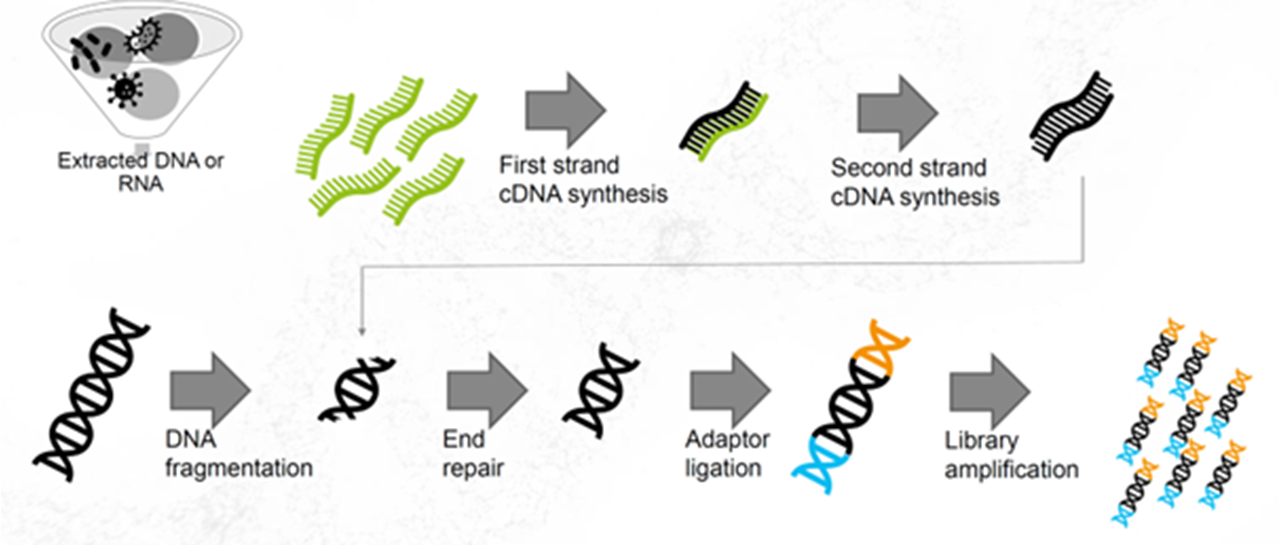
Library preparation is the first step of next generation sequencing. It allows DNA or cDNA to adhere to the sequencing flow cell and allows the sample to be identified. The basic steps of library preparation are fragmentation and end repair, addition of adapters, and (optional), PCR amplification.
Authors Kristian Wittek, Product Manager, Morten Thorsholt, Product Manager and Huma Siddiqui, Product Manager
The MGISeq platform uses a unique DNA nanoball (DNB) technology, which involves the amplification of genomic DNA into nanoballs, followed by sequencing by synthesis (SBS) using fluorescently labeled nucleotides. In nanoball sequencing, DNA fragments are amplified by rolling circle amplification. The original circular DNA fragment serves as a template for the amplification of each clonal copy of DNA. This results in a spherical "nanoball" of amplified DNA. The negatively charged nanoballs are then hybridized to positively charged binding spots on an optimized patterned flow cell.
Once your libraries are prepared, you will be ready for the next step in your next generation sequencing workflow.
You can convert your already prepared library - using standard library preparation methods, into an MGI-compatible library for sequencing on MGI genetic sequencers. This requires, however, an additional step (library conversion) without the need to repeat the entire library preparation process.
The sequencing process then proceeds in a similar fashion to standard SBS sequencing. The nucleotides (A, C, G, or T) are added one at a time to the flow cell, and the incorporated nucleotides are detected by a camera.
Related products

MGI DNBSEQ-G99 NGS/MPS Instrument


For more information please contact